
Top 10 Modern Flat Panel Door Ideas for a Sleek, Minimalist Look
Minimalist interiors don’t rely on decoration.
They rely on proportion, detail, and restraint.
That’s why the flat panel door has become a go-to choice in modern homes, apartments, and hotel projects. It’s simple on the surface. But done right, it’s never boring.
In this guide, we’ll walk through 10 modern flat panel door ideas that focus on real design value. Not buzzwords. Not copy-paste trends. Just ideas that work, photograph well, and elevate space.
1. Shadow Gap Flat Panel Doors

Instead of trim, this door uses negative space.
A narrow shadow gap outlines the door and lets light define the edge. The result feels architectural, not decorative.
Why designers love it:
Clean lines without bulky frames
Strong contrast under natural or directional light
Perfect for minimalist and gallery-style interiors
Think of it like a pencil sketch. One line. No shading. Still powerful.
2. Oversized Panel Doors

Size changes everything.
An oversized flat panel door doesn’t add detail. It adds presence. Taller heights and wider panels stretch the room visually and feel intentional.
Best use cases:
Main bedrooms
Living room transitions
Hotel suites and villas
Bigger doors don’t shout. They whisper confidence.
3. Micro-Texture Flat Panel Doors

A flat panel door doesn’t need to be perfectly smooth.
Micro-textures add depth you only notice up close. That’s the point.
Common finishes include:
Soft sanded lacquer
Subtle stone or mineral texture
Low-sheen tactile coatings
Why this matters:
Reduces fingerprints
Feels warmer than glossy finishes
Looks premium in natural light
It’s the difference between a blank wall and one you want to touch.
4. Flat Panel Doors with Integrated Vertical Handles

No knobs. No add-ons.
Here, the handle becomes part of the door’s geometry. A vertical groove or recessed line runs the height of the panel.
Design advantages:
Keeps the door face clean
Reinforces vertical proportions
Feels intentional, not minimal by accident
This approach balances usability and aesthetics without compromise.
5. Soft Radius Edge Flat Panel Doors

Minimal doesn’t have to mean sharp.
Soft radius edges introduce subtle curves along the door’s perimeter. You won’t notice them at first. But you’ll feel the difference.
Why designers choose rounded edges:
Softer visual language
Safer for homes with kids
Better alignment with modern “soft minimalism” trends
It’s like switching from a hardback book to a leather-bound one.
6. Color Block Doors

One door. One color. No distraction.
Color block flat panel doors treat the door as a solid volume, not a background element.
Popular modern tones include:
Muted olive
Warm taupe
Clay or terracotta
Soft charcoal
This works best when walls stay neutral. Let the door do the talking.
7. Vertical Wood-Grain Flat Panel Doors

Wood doesn’t have to look traditional.
When the grain runs vertically, it emphasizes height and brings rhythm to minimalist spaces.
Why vertical grain works:
Makes ceilings feel taller
Adds warmth without ornament
Pairs well with Japandi and modern natural styles
Use consistent veneer patterns. Random grain kills the effect.
8. Pocket Doors

Sometimes the best door is the one you don’t see.
Pocket flat panel doors slide completely into the wall. When open, they disappear.
Ideal for:
Small apartments
Open-plan layouts
Walk-in closets and bathrooms
This isn’t about saving space alone. It’s about keeping lines uninterrupted.
When discussing hidden sliding solutions like pocket doors, it’s worth noting that frameless pocket systems that disappear into walls help create seamless connections and maximize flexibility in minimalist layouts.
9. Full-Height and Pivot Flat Panel Doors
If you want a flat panel door to feel architectural, go taller—or change how it opens.
Full-height flat panel doors, often matching the wall height, remove the visual break created by headers and trim. The wall reads as one continuous surface. The door feels calmer, cleaner, and more intentional. This is especially effective in minimalist homes, luxury apartments, and hotel suites where visual flow matters.
Pivot flat panel doors take it a step further. Instead of side hinges, the door rotates on a central or offset pivot. The movement feels lighter and more controlled, even at large sizes. Because the surface stays perfectly flat, the door looks sculptural without adding detail.
Why designers choose this approach:
Enhances ceiling height and room proportion
Reduces visual clutter around openings
Creates a premium, custom-built experience
Flat panel door designs work exceptionally well here. No panels, no profiles—just scale, balance, and motion doing the work.
If minimalism is about control, this is control at its best.

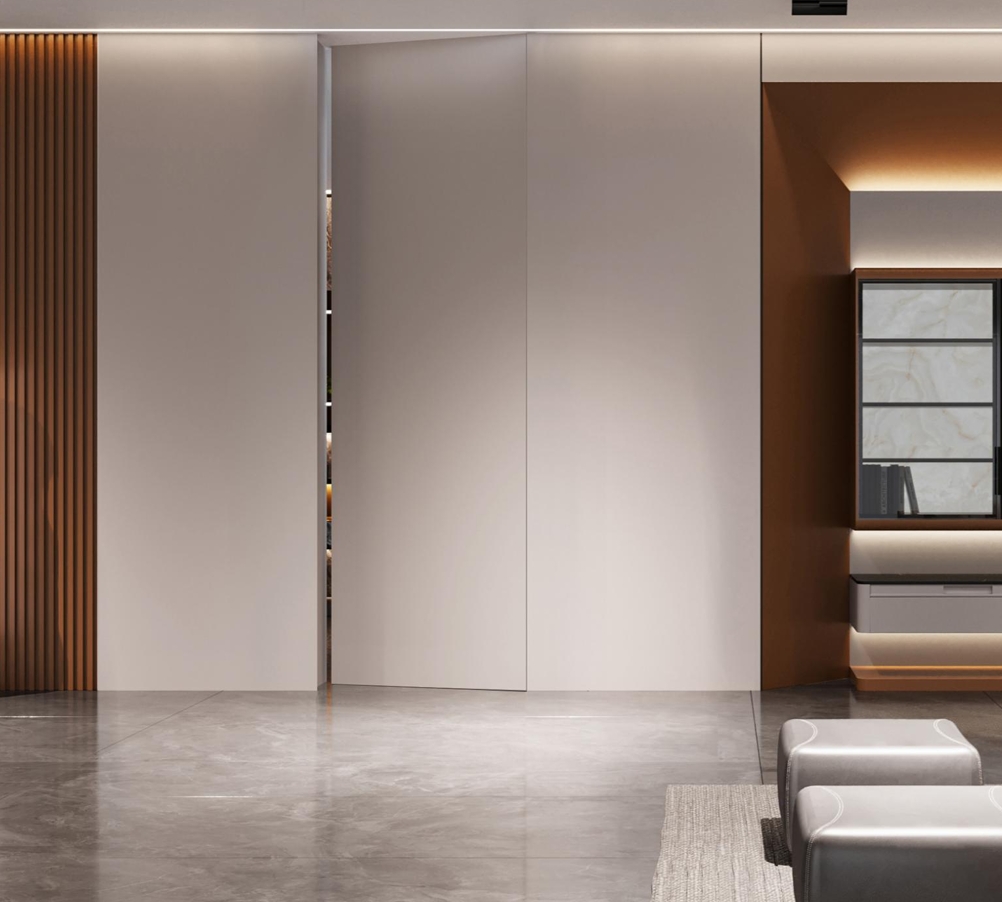
10. Flush Flat Panel Doors Integrated with Wall Panels
Here, the flat panel door stops being an object.
It becomes part of a wall system.
Key features:
No visible frame
Continuous panel alignment
Consistent joints and spacing
This approach is common in high-end residential projects and hotel fit-outs. It demands precision. But the payoff is unmatched visual calm.
Why Flat Panel Doors Dominate Modern Design
According to design platforms like ArchDaily and Houzz, minimalist interiors continue to favor elements that reduce visual noise and emphasize structure over decoration.
The flat panel door fits that philosophy perfectly:
Fewer parts
Fewer distractions
More control over space
Good design doesn’t add. It edits.
refer to:The Overlooked Art of Door Design: An Introductory Guide to Interior Door Types
Final Thoughts
A flat panel door isn’t just a style choice. It’s a design decision.
The best results come from understanding what drives the look:
Proportion
Texture
Color
Integration
Pick one idea. Execute it well. Let the rest of the space breathe.
That’s how minimalist design stays interesting—without trying too hard.
FAQs About Flat Panel Door
Are flat panel doors modern or traditional?
Flat panel doors are considered modern, especially in contemporary and minimalist homes. While similar profiles existed in the past, today’s flat panel door designs focus on flush surfaces, hidden details, and architectural proportions.
Are flat panel doors more expensive than traditional doors?
Not always. A basic flat panel door can be cost-effective. Prices increase when you add features like full-height sizing, pivot systems, custom finishes, or integrated wall panels.
What’s the difference between a flat panel door and a slab door?
The terms are often used interchangeably. Technically, a slab door refers to the door leaf without hardware, while a flat panel door describes the design style—a smooth, flat surface.
What style of home works best with flat panel doors?
Flat panel doors work best in modern, minimalist, contemporary, and Japandi-style homes. They are also widely used in luxury apartments and hotel interiors where visual simplicity matters.


